
The Government has published proposals to reform the SEND system. These proposals are part of the wider Schools White Paper and related SEND reforms. Parent Carers are being asked to respond to 39 specific questions about the SEND reform.
As parent carers ourselves we know how difficult it can be finding the time to read such a large amount of information and respond to a long consultation. We’re here to help. Each week we will focus on an aspect proposed changes, and ask you to share your views in series of short, bite-size surveys making it quick and easy to share what matters most to you.
What is being proposed?
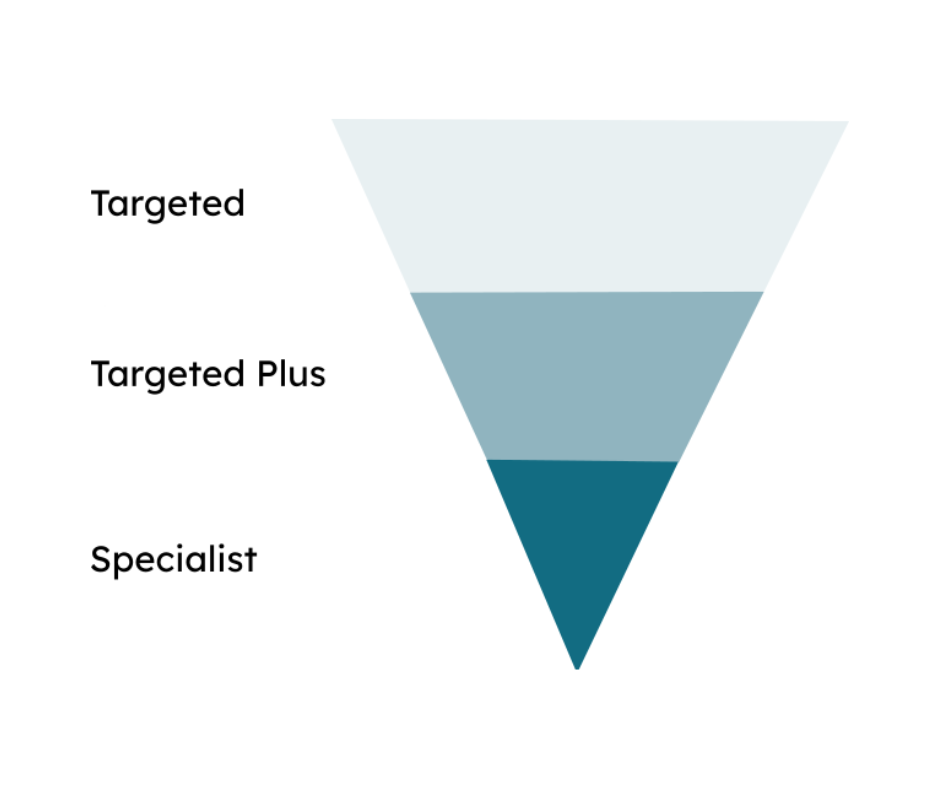
The Government is proposing a new structure for how support is planned and recorded for children and young people with SEND. In addition to the National Inclusion Standards, the Government is proposing new tiered levels of support. All children will receive a Universal offer of support through the National Inclusion Standards. If a child or young person requires support above this level the following tiers of support will be available: Targeted, Targeted Plus, Specialist.
-
Children and young people get Targeted support from their setting, outlined in an Individual Support Plan that is developed with parents.
-
Children and young people get Targeted Plus support from their setting, with input from education and health professionals. School-aged children are also supported through their school group. Support may include access to a “Support Base”.
-
Children and Young People receive Specialist support through an EHCP in a mainstream or specialist setting, if they require provision set out in one of the new nationally defined Specialist Provision Packages. Support may be delivered through a “Specialist Base”.
Individual Support Plans:
All children who require support provision within these three tiers will have an Individual Support Plan (ISP) and schools would have a duty to put this plan in place. Children who require Specialist support will have both an Education Health Care Plan (EHCP) and ISP.
What we know about the proposed ISP’s:
Schools would be required to create ISP’s for children who need support at Targeted level and above.
Settings will be required to create digital ISP’s.
The plan will describe the child or young person’s day-to-day educational provision and support required facilitating smooth transitions.
The plan will be created collaboratively with parent carers.
The plans are described as digital and consistent across all schools and local authorities, with the aim of creating a clearer and more structured approach to support.
The intention is to make it clearer what support should be provided at each level of need.
There will be a requirement for Individual Support Plans to be reviewed annually at a minimum, which will involve discussions with parent carers.
The use and quality of Individual Support Plans will be assessed through Ofsted’s inspections and assessment of SEND provision at a setting level.
ISPs do not have the same legal enforceability as an EHCP.
Targeted Plus:
For a student within the Targeted Plus tier who may need more specialist support to thrive in mainstream education, an ISP will set out the support they should receive from their school and could include evidence-based interventions within the setting from external education, health and care professionals (Experts at Hand). Support could also include a child or young person receiving some of their education in an Inclusion Base within their setting.
Experts at Hand:
This is a new offer of expert advice and services from education and health professionals into mainstream settings. The Government are proposing to invest £1.8 billion over the next three years to create this new national offer ‘wrapping’ professionals such as Educational Psychologists, Speech and Language Therapists and Occupational Therapists around mainstream settings. The hope is that this will change the inconsistent and limited access many settings are currently experiencing.
The Government anticipates that by the end of the academic year 2028 to 2029, funding would mean that a typical school could benefit from annual support which is equivalent to 40 days per average primary school and 160 days per average secondary school.
However, there is a recognition that ‘scaling up’ to achieve this offer of support will take time and there is an expectation that initially the focus will be on upskilling education staff to raise baseline knowledge across mainstream settings. It is hoped that over time, more expert time will shift to bespoke advice and group-level support for children and young people, with education staff increasingly being able to deliver interventions themselves.
As yet, there are no specific plans on how to deliver this offer of support to early years and Post-16 sectors.
Inclusion Bases:
The Government are proposing to replace the current terms SEN unit, resourced provision, and pupil support unit (sometimes referred to by settings as ‘internal alternative provision’) and will instead collectively describe this provision as Inclusion Bases.
These will sit within mainstream settings and will be underpinned by two models:
‘Support Bases’ – commissioned and funded by individual settings and multi academy trusts to deliver targeted support;
‘Specialist Bases’ – commissioned and funded by the local authority to deliver specialist support.
The Government will invest at least £3 billion between the 2026/27 and 2029/30 financial years to create new special school places and tens of thousands of new places in Inclusion Bases.
Under the proposed new system, there will be an expectation that every secondary school will have an Inclusion Base, with an equivalent number of places in local primary schools. The hope is that this will build on and strengthen the inclusive support in place.
The Government plan to work with Ofsted to develop early insights into how mainstream settings are improving inclusion and this will include a review of the use of Inclusion Bases in schools.
The hope is that the use of Inclusion Bases will allow for more children and young people to receive specialist support closer to home and will make it easier for parents to understand the support available for their child.
What we don’t yet know:
The details of the support criteria that will be in each of the tiers - Targeted, Targeted plus and Specialist
What an Individual Support Plan will look like
How the Experts at Hand offer will operate
If and how an Individual Support Plan can be challenged or enforced
What support will be given to parent carers who wouldn’t be able to access digital ISP’s
What support will be provided to parent carers for whom English is a second language
How the Government will address gaps in recruitment and retention of key staff members.
How Inclusion Bases will be staffed and how they will operate in practice
What training will be provided to staff within the Inclusion Base
How the recommended provision will support and develop the social, emotional and mental health of children and young people
It is important to remember that these proposals are still being consulted on, and the detail of how they would work in practice if they come into law are still being developed. It is important that you have your say and respond to the consultation. The link to our Bitesize survey is below
SGPC Bitesize Survey - 3 of 8
This week we are asking for your thoughts on the plans for Trageted and Targeted Plus support
Bite Size Survey: Targeted and Targeted Plus
Each survey only takes a few minutes, but your voice can make a real difference. Ensure that the perspectives of families in our community are heard.
Focused news and accompanying bite-sized surveys will be shared each week week until the 29th April. All surveys will remain open till midnight on Sunday 3rd May
Check out the SGPC updates page to see them all
We are now in a 12-week consultation period.
There are two ways that you can have your say:
Through the Government Consultation Survey on SEND reform - Closing Date 11:59pm 18 May 2026,
Through South Glos Parent Carer Forum’s bite size surveys. - Closing Date 11:59pm 3 May
If possible, we would always recommend that you complete both feedback options.
At SGPC, our role remains the same: to represent the lived experience of parent carers in South Gloucestershire and to ensure that your voices are heard locally and nationally.
We know that system change must improve outcomes for children and young people with SEND. We will work alongside the NNPCF and partners to ensure that reforms lead to positive, meaningful and sustainable change for families.
We will continue to update families as more detail becomes available through our social media, website and members email list:

You are not alone
We recognise that change can bring uncertainty and questions. You are not alone, our drop-in support sessions and online email support are here for you.
See details of all our support session opening hours here
March 2026